
 International
  Politics
  Local
Local  Finance
  Sports
  Entertainment
  Lifestyle
  Technology
  Literature
  Science
  Health
  1 hour ago
4
1 hour ago
4
Bitcoin’s realized profit and loss ratio has fallen to -0.35, a 43-month low last seen after FTX’s collapse, flashing what Cryptoquant calls a bottom signal just as Michael Saylor’s Strategy turns seller.
Key Takeaways
- Cryptoquant said bitcoin’s realized P/L ratio hit -0.35, its lowest reading since December 2022 after FTX fell.
- The signal flashed as Strategy sold 3,588 BTC for $216 million and bitcoin rebounded above $64,000 on July 7.
- Swan Bitcoin’s Adam Livingston noted similar discounts preceded 41% six-month and 81% one-year returns.
A Loss Gauge at FTX-Era Depths
Blockchain analytics platform Cryptoquant has spotted a signal that bitcoin bulls have been waiting months for. The realized profit and loss ratio (a metric measuring the net percentage of bitcoin supply sitting in profit or loss relative to total supply) has dropped to -0.35, its lowest reading in 43 months.
The last time the gauge fell this far was December 2022, in the depths of the bear market that followed the collapse of crypto exchange FTX, when bitcoin traded below $16,000. The firm’s analysts wrote that the indicator has historically marked BTC bottoms “with extreme precision,” with comparable prints in 2015 and 2019 also preceding major recoveries rather than further crashes.
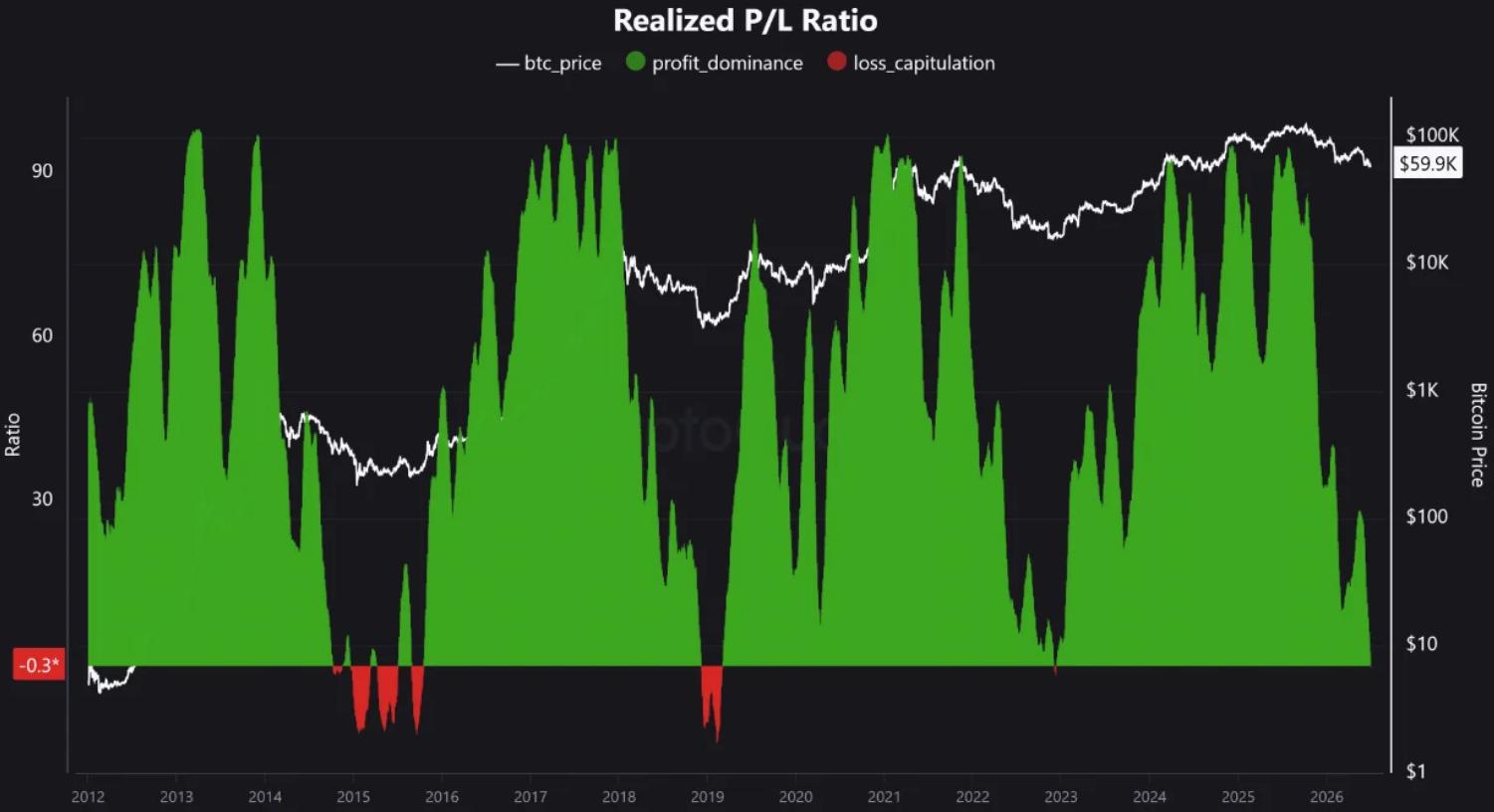 Bitcoin’s P/L ratio is at historic lows, suggesting a bottom, per Cryptoquant
When this much of the supply is underwater, the holders most likely to panic-sell have largely already done so, leaving fewer sellers to push the price lower. At the time the data was captured, bitcoin traded near just under $60,000, only about 16% above its realized price (i.e. the average cost basis of all coins on the network).
Selling Into the Signal
The reading arrives at a loaded moment for the market, because the highest-profile seller is bitcoin’s most famous permabull. Strategy Inc. (Nasdaq: MSTR), the treasury firm led by executive chairman Michael Saylor, disclosed in a regulatory filing on July 6 that it sold 3,588 BTC for roughly $216 million between June 29 and July 5, using the proceeds to fund preferred dividends and rebuild its dollar reserves to $2.55 billion.
The sale was quickly absorbed by the market, but bitcoin still remains roughly 50% down from its October 2025 record of $126,080. That said, it has held the $60,000 area through the heaviest selling pressure of the cycle so far.
Swan Bitcoin’s Adam Livingston noted that when bitcoin has traded at comparable discounts to its trend, forward returns have averaged 41% over six months and 81% over twelve months. Moreover, Bernstein analyst Gautam Chhugani is of the view that the current 54% drawdown remains far smaller than the 75% to 90% declines that ended previous cycles, and the Wall Street firm maintained a constructive long-term view.
Even Strategy’s sale is being reframed as bottom fuel with Grayscale Head of Research Zach Pandl arguing that the company’s shift to selling bitcoin as needed for its dollar reserves reduces tail risk and “could help bitcoin find a more durable bottom.”
None of this makes the bottom certain because onchain indicators can only describe conditions, not offer guarantees. Macro pressure from the unwinding artificial intelligence (AI) trade and continued exchange-traded fund (ETF) outflows could still test the lows, and Strategy’s monetization program leaves room for up to $1.25 billion in total sales.












 English (US)