
 International
  Politics
  Local
Local  Finance
  Sports
  Entertainment
  Lifestyle
  Technology
  Literature
  Science
  Health
  2 hours ago
4
2 hours ago
4
The Bitcoin Puzzle Challenge, a decade-old onchain bounty system now holding roughly 916.52 BTC worth approximately $58.87 million at current prices, sits at a new frontier as community solvers push past Puzzle 70 and set their sights on a 71-bit keyspace target that pool telemetry suggests could take centuries to brute-force.
Key Takeaways
- The Bitcoin Puzzle Challenge holds 916.52 BTC worth roughly $58.87M across 78 unsolved addresses as of June 2026.
- Puzzle 71 is the lowest remaining address-only target, with pool telemetry projecting 421 years at current speed.
- Solvers targeting known-public-key puzzles 135 through 160 can apply Pollard’s Kangaroo, reducing the algorithmic cost significantly.
A Challenge Built Over a Decade
The puzzle did not begin as the massive bounty system it is today. Its earliest verified onchain origin is a Jan. 15, 2015, transaction that funded 256 outputs with rewards scaling from 0.001 BTC to 0.256 BTC, totaling 32.896 BTC. A Bitcointalk thread opened Dec. 28, 2015, under the title “ Bitcoin puzzle transaction ~32 BTC prize to who solves it” marked the first major public discussion of the challenge.
 A simulated flow chart using mempool.space visuals of the original Bitcoin Puzzle Challenge transfer that occurred on Jan. 15, 2015. The entire batch payment was confirmed at block height 339085.
The structure changed materially in 2017 when funds from addresses 161 through 256 were moved into the lower-range addresses, consolidating the challenge to 160 active puzzles. In 2019, the creator sent small outgoing transactions from every fifth address in a sequence that included 65, 70, 75, 80, and up through 160. Those partial spends revealed public keys onchain for those outputs, a detail that later proved significant for how solvers could approach those specific puzzles.
The bounty reached its modern scale in April 2023, when prizes across unsolved puzzles were increased by roughly 10 times. Puzzle 66 rose to 6.6 BTC. Puzzle 160 reached 16 BTC. Current trackers report an aggregate reward of approximately 989.04 BTC.
Where the Frontier Stands Now
As of mid-June 2026, community trackers show 82 of the 160 puzzles solved and 78 remaining. With bitcoin trading around $64,232, the unsolved pool carries a spot value near $58.87 million.
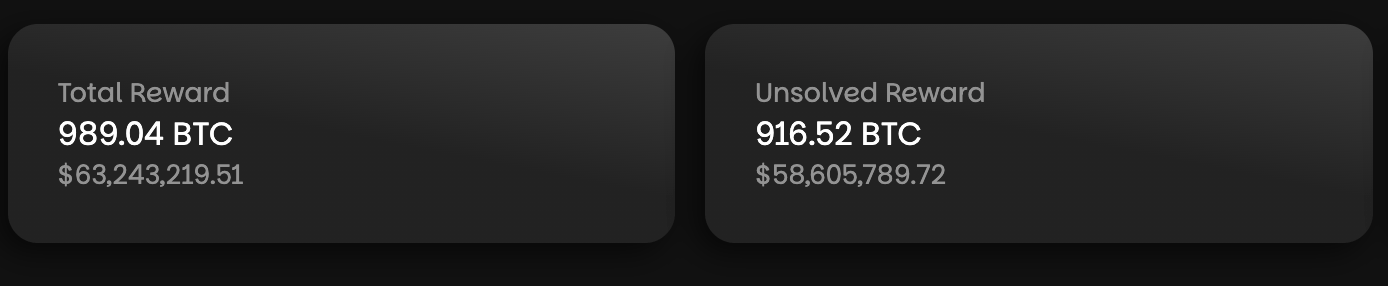 Statistics from btcpuzzle.info on June 23, 2026.
The creator behind the challenge remains anonymous in any provable sense. The handle most commonly cited in forum history is saatoshi_rising, which later Bitcointalk posts attribute to an “I am the creator” claim. Comments attributed to that account describe the puzzle keys as consecutive outputs from a deterministic wallet with leading bits masked to set difficulty, and frame the whole exercise as a measuring instrument for community cracking strength rather than a puzzle with a hidden algebraic trick. That attribution is influential but unverified.
Puzzle 71: The Next Target
Solvers who track outdated guides may still see Puzzle 66 listed as the easiest remaining target. It is not. Trackers now mark puzzles 69 and 70 as solved. The current lowest-numbered unsolved address-only target is Puzzle 71, which carries approximately 7.1 BTC and requires searching a keyspace in the range from 2^70 to 2^71.
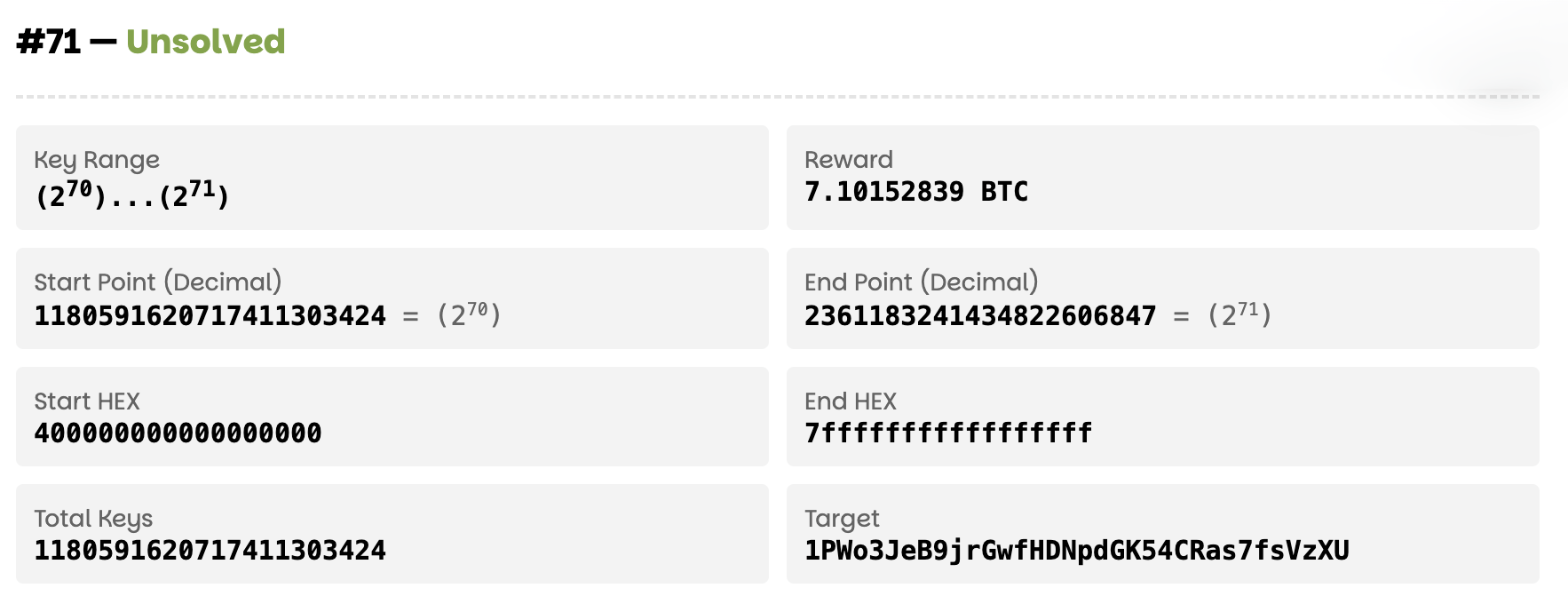 Statistics from btcpuzzle.info on June 23, 2026.
That one-bit increase over the prior puzzle doubles the raw search work. Each step upward in the puzzle sequence works exactly that way.
A June 23, 2026, snapshot from btcpuzzle.info put the scale in concrete terms: the community pool had scanned 290,012 of 33,554,432 assigned ranges, was operating at 57.3 billion keys per second, had covered 0.864 percent of the total puzzle space, and was on pace to complete the search in roughly 421.92 years at the average speed recorded at that moment.
Two Classes of Targets
The unsolved puzzle set splits into two distinct categories, and the approach differs depending on which type a solver targets.
For address-only puzzles such as Puzzle 71 and its neighbors 72, 73, and 74, the method is brute force: test candidate private keys within the allowed interval, derive the corresponding address, and look for a match. For puzzles where a public key is already known onchain, a different class of algorithm applies.
Puzzles 135, 140, 145, 150, 155, and 160 currently have known public keys. When a public key is available, solvers can apply Pollard’s Kangaroo method, an interval discrete logarithm approach with square-root-type complexity in the size of the interval. The JeanLucPons Kangaroo project, built specifically for the secp256k1 curve with multi-GPU support, is the most widely cited public implementation of this method.
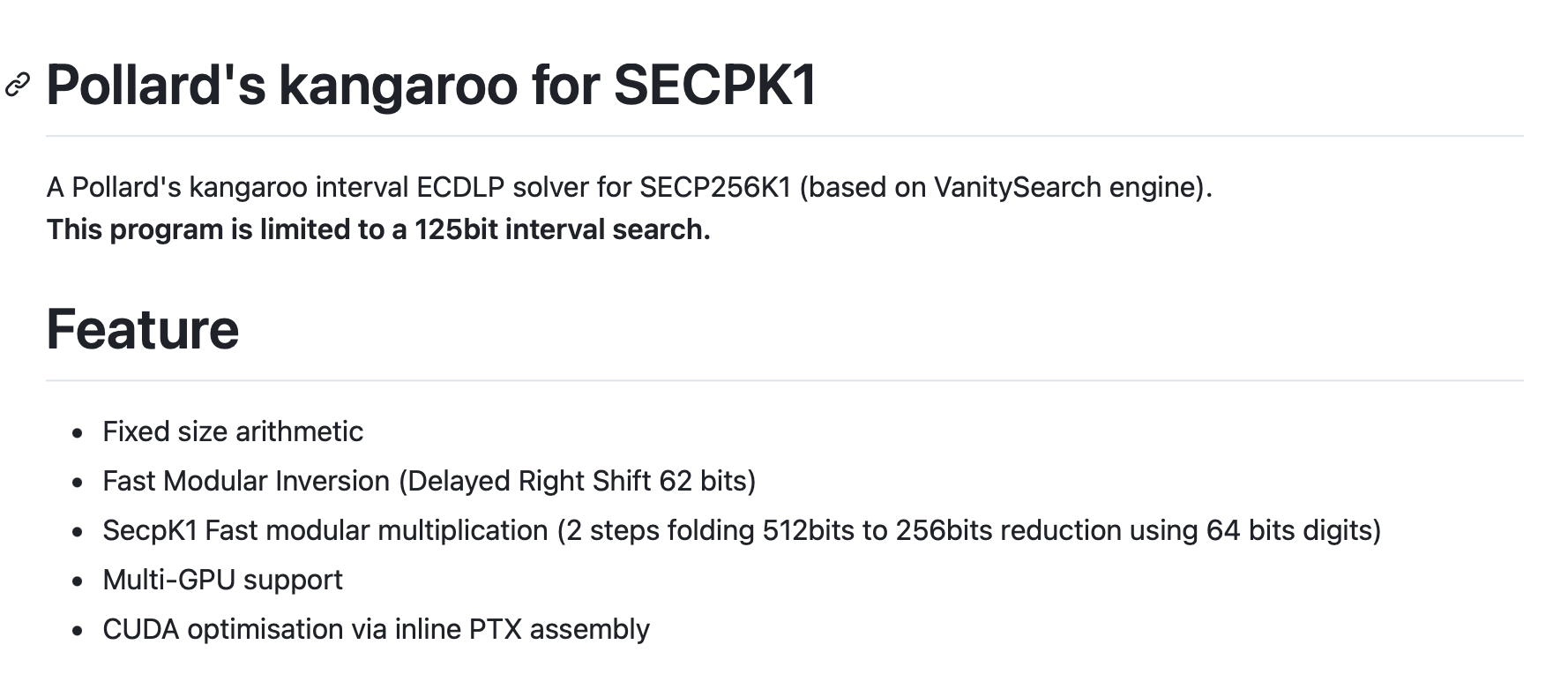
That distinction is not academic. Known-public-key puzzles offer a material algorithmic advantage over address-only targets of similar bit depth, even though they are still enormous undertakings.
The Software Stack
Three codebases dominate community discussion. Bitcrack, maintained on Github by brichard19, is the established reference for GPU-based address scanning on the lower-difficulty address-only puzzles. Keyhunt by albertobsd supports multiple attack modes, including raw address matching and discrete-log workflows, making it the most versatile public option across both target classes. JeanLucPons’ Kangaroo handles the known-public-key interval attacks.
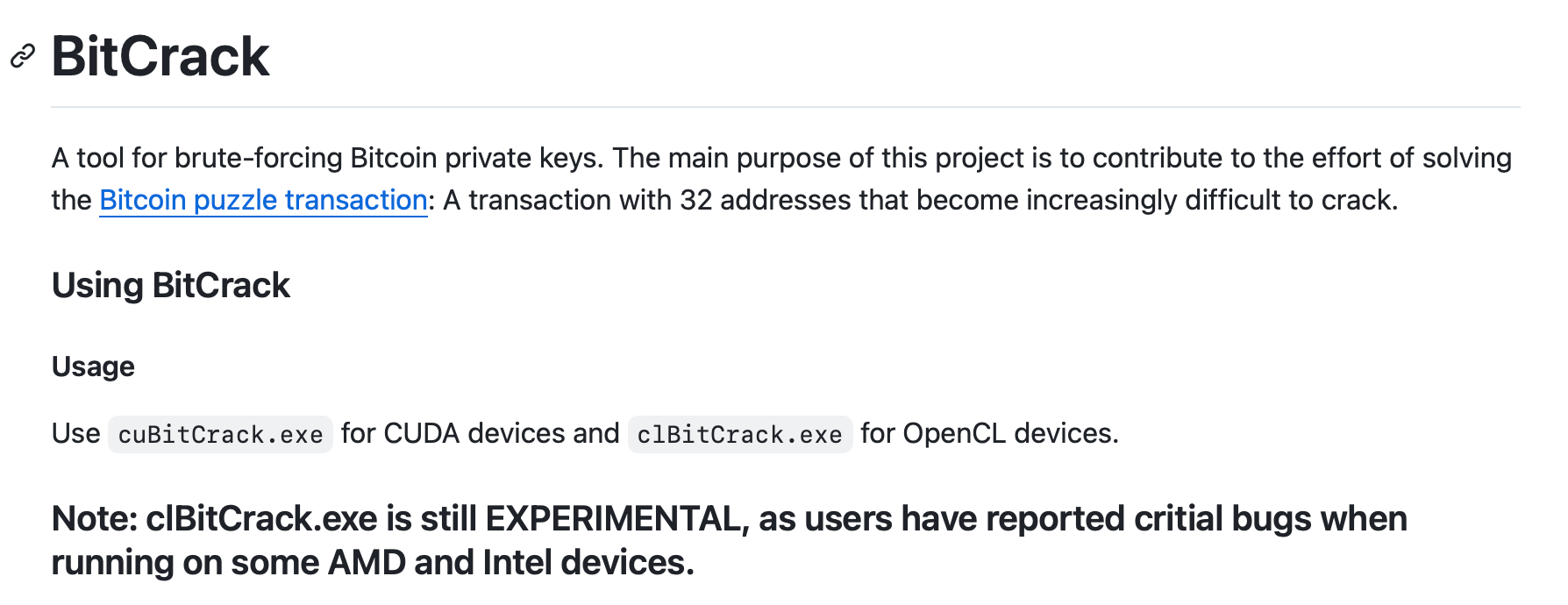 Bitcrack is a GPU-accelerated command-line tool designed to brute-force Bitcoin private keys using CUDA and OpenCL. Its primary objective is to assist in solving the Bitcoin puzzle transactions by scanning large ranges of keyspaces for specified target addresses.
Pool infrastructure such as btcpuzzle.info distributes the work across contributors by slicing the interval into hex subranges and assigning them to participating workers. That coordination layer is range accounting and telemetry, not a new cryptographic method.
Finding the Key Is Not the Whole Game
Community history around puzzles 66 through 69 documents a risk that solvers who focus only on the cryptographic challenge tend to overlook. When a private key is exposed to the public mempool before a spend is confirmed, observers can extract the public key from the pending transaction. That converts a pure address-hunting problem into a known-public-key interval problem, which faster algorithms can then attack.
Recent solve history for puzzles 67 and 68 involved transactions that did not travel through the ordinary public mempool path. The practical implication is clear: successfully claiming a reward requires managing the final transaction with the same care as the key search itself.











 English (US)