
 International
  Politics
  Local
Local  Finance
  Sports
  Entertainment
  Lifestyle
  Technology
  Literature
  Science
  Health
  1 year ago
76
1 year ago
76
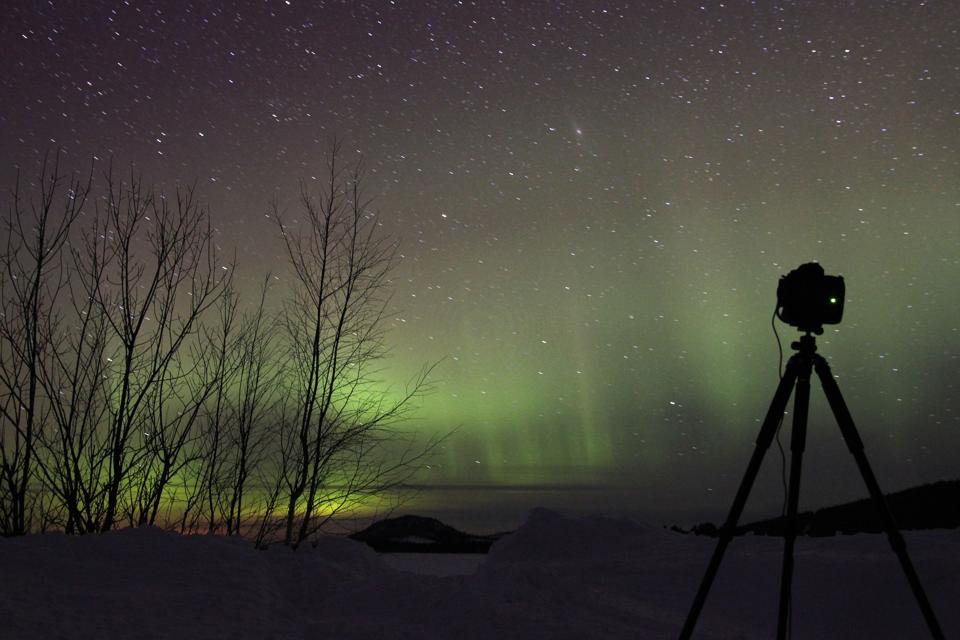
Photographic aurora are possible in the U.S. this weekend.
gettyThe Northern Lights may be visible on camera — and possibly to the naked eye — in the U.S. as soon as it gets dark on Saturday, June 14, according to the National Oceanic and Atmospheric Administration’s Space Weather Prediction Center, with forecasts including a "strong" geomagnetic storm that could be visible from 18 U.S. states. Solar activity is currently at a 23-year high due to the current solar maximum period.
Northern Lights Forecast: Where And When
The latest forecast has a G2 (moderate) geomagnetic storm on June 14. However, NOAA states that there's a slight chance for a G3 (strong) geomagnetic storm — and that's why this forecast is worth knowing about. “Aurora has been seen as low as Illinois and Oregon (typically 50° geomagnetic latitude),” according to NOAA, though its aurora view line has the phenomenon potentially visible from parts of 18 states.
Parts of U.S. states that could potentially see aurora, according to NOAA, include Washington, northern Oregon, northern Idaho, Montana, Wyoming, North Dakota, South Dakota, Nebraska, Minnesota, northern Iowa, Wisconsin, northern Illinois, northern Indiana, Michigan, New York, Vermont, New Hampshire and Maine.
Check NOAA's 30-minute forecast or use the Glendale App for up-to-the-minute forecasts.
Northern Lights Forecast: Latitude And Time Of Year
All forecasts for the Northern Lights must now be viewed with suspicion. Late June is not traditionally considered the aurora-viewing season in the Northern Hemisphere, which is typically thought to be from September to March. That's because there are now so few hours of darkness, with no astronomical darkness around the U.S.-Canada border and farther north. Although aurora can occasionally be seen in deep twilight, the display needs to be strong and the timing of outbursts fortunate.
Breathless forecasts have persisted through April, May, and June, partly due to inexperienced reporters and partly because the current solar maximum is experiencing repeated heightened activity from the sun.
Northern Lights Forecast: How To Photograph Aurora
It's best to think of the Northern Lights in June as a photographic opportunity. Although you may see some structure with the naked eye, having a mirrorless or DSLR camera is the way to go — though newer models of flagship smartphones also do an excellent job of capturing aurora.
If your smartphone has a “Night Mode” feature, that should be good enough to get a more than impressive souvenir shot of the aurora. It likely means a long exposure of between five and 10 seconds, which will look much better if you do three things:
- Use your primary lens, NOT the super-wide lens (which is inferior).
- Use a basic smartphone holder and a small tripod to minimize camera shake, ensuring your images remain sharp. Failing that, support your phone on a solid surface, such as a gatepost or vehicle.
- Shoot in raw if you have the option, which makes it easier to improve your photos with simple edits.
What Causes The Northern Lights
The Northern Lights are caused by the solar wind, a stream of charged particles from the sun interacting with Earth’s magnetic field. Although the magnetic field deflects much of it, some charged particles accelerate along the magnetic field lines toward the polar regions, where they collide with oxygen and nitrogen atoms, exciting them and causing them to release energy as light.
The forecast takes into account the effect of a coronal mass ejection — a burst of charged particles from the sun traveling through space and striking Earth’s magnetosphere — on June 8. A coronal hole in the sun is also causing a high-speed, turbulent solar wind.
Wishing you clear skies and wide eyes.










 English (US)