
 International
  Politics
  Local
Local  Finance
  Sports
  Entertainment
  Lifestyle
  Technology
  Literature
  Science
  Health
  1 month ago
27
1 month ago
27
19 minutes ago
Chris BaraniukTechnology reporter

 Jacob Clothier/Lancaster University
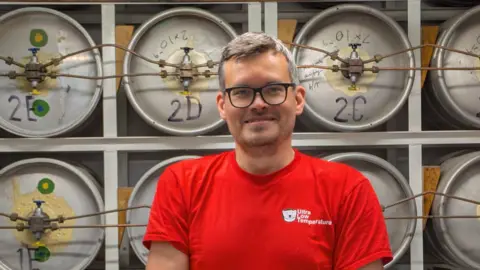
Dima Zmeev in front of Lancaster University's valuable supply of helium-3
One of the most valuable assets owned by Lancaster University is stored in beer kegs.
But it's not in one of the student bars.
In a carefully locked laboratory rows of metal kegs are arranged on shelves and linked together with spindly copper pipework.
The containers aren't loaded with prize beer but rather a gas called helium-3, one of the most expensive materials in the world. A single litre costs roughly $2,000 (£1,500), though the price can fluctuate.
"The lab has been going for 50 years or so. Back then, the helium was quite cheap," says Dima Zmeev, senior lecturer. "Our very wise predecessors stocked up."
In the near future, more people could be looking to build up such a stockpile. Helium-3 has applications in quantum computing and nuclear fusion. However, the main source of it today is tightly controlled – it comes from nuclear weapons. Specifically, from the decay of tritium, a form of hydrogen, inside those weapons.
Around the world, tens of thousands of litres of helium-3 are likely to be produced this way every year, estimates David McCollum, distinguished scientist at Oak Ridge National Laboratory in Tennessee. But future demand could far exceed that supply.
Some entrepreneurs and researchers say we need new sources of helium-3. It exists in the ground, though generally at very low concentrations.
However, samples of moon dust, or regolith, from the Apollo missions suggest it may be present there at relatively high concentrations. As such, plans are now afoot to recover helium-3 from the moon.
Helium-3 is an isotope of helium, defined by the number of neutrons in the atom's nucleus. Helium-4, with one additional neutron, is the comparatively cheap version – a gas that fills children's party balloons.
Zmeev uses helium-3 in physics experiments. For example, he fills tiny chambers with the stuff, in a project to detect a type of mysterious dark matter particle.
Should such a particle knock into one of the helium-3 atoms, it would make them all jiggle. This generates heat and that slight temperature rise can be measured.
The helium-3 can be re-used again and again.
Scientists mix helium-3 and helium-4 together at very low temperatures to create the lowest temperatures in the known universe, down to the millikelvin range (-273C).
When helium-3 atoms gradually separate from a dilute mixture containing the two isotopes, they form a pure helium-3 layer on top. This separation is a phase change that consumes energy, inducing a cooling effect, like when steam evaporates off a cup of hot water.
Helium-3-based cooling, or dilution refrigeration, is crucial for quantum computers.
 InterLune
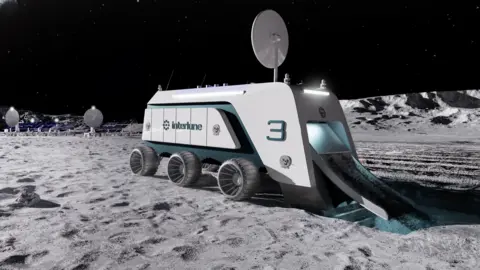
InterLune has plans to put autonomous mining machines on the Moon
One company planning to extract helium-3 from the moon is Interlune, based in Seattle. "We've spent the last four years developing, prototyping and testing technologies… We have a team of 30 people, and growing," says Rob Meyerson, co-founder and chief executive. Meyerson was president of Blue Origin, Jeff Bezos' rocket company between 2003 and 2018.
One of Interlune's co-founders is Harrison "Jack" Schmitt, now in his 90s, who walked on the moon during the Apollo 17 mission. He has long advocated recovering helium-3 from lunar regolith.
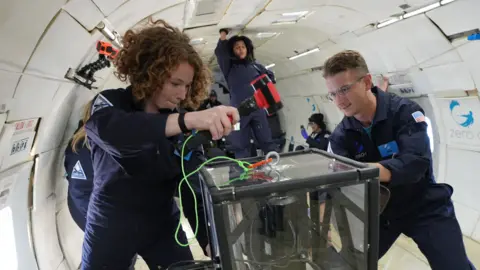
Interlune has tested some of its equipment during parabolic flights, in which a plane flies in a big arc to simulate zero gravity. The firm's kit could be integrated into a lunar lander as early as autumn 2027, says Meyerson.
Eventually, Interlune aims to place autonomous, regolith-shovoelling excavators on the moon to scoop up the powdery material and process it. The idea is to crush and churn the regolith, releasing helium-3 contained within it.
 Steve Boxall
InterLune has tested some of its equipment in low-gravity simulation flights
No-one knows with certainty what kind of helium-3 concentrations are present on the moon.
Paul Burke, at Johns Hopkins Applied Physics Laboratory, says Apollo regolith samples might have lost some of their helium-3 on their return to Earth, skewing our understanding of how much is there.
Plus, there might not be as many helium-3 hotpots as hoped, or they could be depths that are difficult to access. "It's important that we understand where the helium-3 is," says Burke.
As Space News reported last year, lunar concentrations – perhaps between a few parts per billion (ppb) and 20-something ppb – could require excavating and processing hundreds of thousands of tonnes of the regolith just to obtain one kilogram of Helium-3. A "mountain-moving" prospect, says Burke.
"We're not ignoring the fact that we've got to process large amounts of regolith," says Meyerson. Is the plan economically sensible? "We have run the numbers… for everything we need to get to the moon, extract the [Helium-3] and bring it back to Earth."
Interlune declined to share those numbers with the BBC, or estimates for the total cost of developing its technology.
Another US company, Astrotech Corporation, has also announced its intention to go to the moon. In its case, via a SpaceX Starship rocket. Astrotech would extract helium-3 from regolith by heating it up. Tom Pickens, chief executive and chief technology officer says, "All of it is challenging."
In previous space-based applications, his company made mass spectrometers, instruments that identify materials such as chemical elements and measure their concentrations.
Work continues on a prototype for lunar helium-3 extraction and Pickens is bullish: "You'll see it."
The company has "seven or eight" people working on the project, he adds.
Quantum computers could eventually require thousands of litres of helium-3, depending on their design, suggests McCollum. He and colleagues recently published a paper scrutinising the energy and resource requirements of these devices.
This means that the lunar helium-3 projects are already attracting interest. Helsinki-based quantum computing company has signed a $300m (£223m) deal with Interlune, for 10,000 litres of helium-3 annually from 2028-37.
 Pulsar Helium
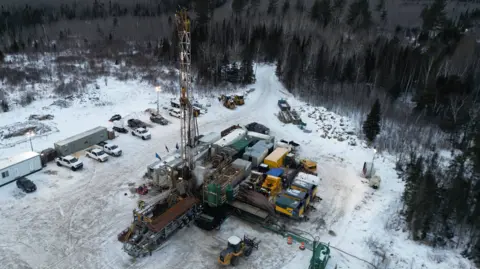
This site in Minnesota is being investigated for helium-3
But there are alternatives. Some scientists are working on methods of cooling quantum computers that don't rely so heavily on helium-3, for example, points out Richard Easther at the University of Auckland.
And helium-3 hunters might be able to recover useful volumes of from the Earth's crust after all. Pulsar Helium, headquartered in Portugal, is investigating the presence of helium-3 at a site in Minnesota.
Concentrations there are around 12ppb says Peter Barry, a geochemist at Woods Hole Oceanographic Institution and a scientific advisor to the company.
Conventional drilling could potentially yield helium-3 from the ground there he says, adding, "Minnesota is a lot easier to get to than the moon."









 English (US)